Welcome to the Mathematical World!
Leonardo da Vinci (1452 – 1519)
Renaissance Polymath Integrating Mathematics, Art, and Engineering
Leonardo da Vinci used mathematics as a tool to understand proportion, perspective, and motion in art, architecture, and engineering. His sketches reveal careful geometric analysis, ranging from Platonic solids to the proportions of the human body, blending aesthetic vision with numerical precision. For example, he applied ratios such as the golden ratio \[ \phi = \frac{1 + \sqrt{5}}{2} \approx 1.618, \] to study harmony and balance in compositions and structures.
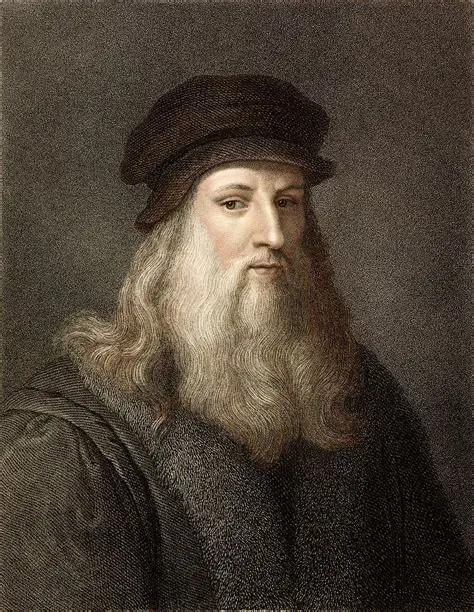
Though not a mathematician in the traditional sense, Leonardo applied mathematical reasoning to design machines, study fluid dynamics, and explore mechanics, foreshadowing modern engineering. His collaboration with Luca Pacioli exemplified the Renaissance fusion of art and science, demonstrating that mathematics could describe both natural and constructed forms.
Leonardo’s notebooks show how observation, measurement, and calculation can inform creativity, turning abstract concepts into tangible solutions. By using math to model reality, he anticipated modern approaches to biomechanics, structural design, and applied physics.
His emphasis on proportion and symmetry influenced architecture, painting, and mechanical design, creating a lasting legacy where mathematics, art, and science converge seamlessly.
Facts:
- Born in Vinci, Italy.
- Studied perspective and geometry to enhance artistic and architectural work.
- Drew Platonic solids for Pacioli’s publications.
- Designed machines and mechanical devices with mathematical precision.
- Blended art and science seamlessly, anticipating modern engineering and applied physics.

All rights reserved by the Mathematical Unity
Contact: +8801400044645
Email: mathematicalhorse1453@gmail.com
Our Discord Server: Mathematical Unity [Ulus Riyadiyat]